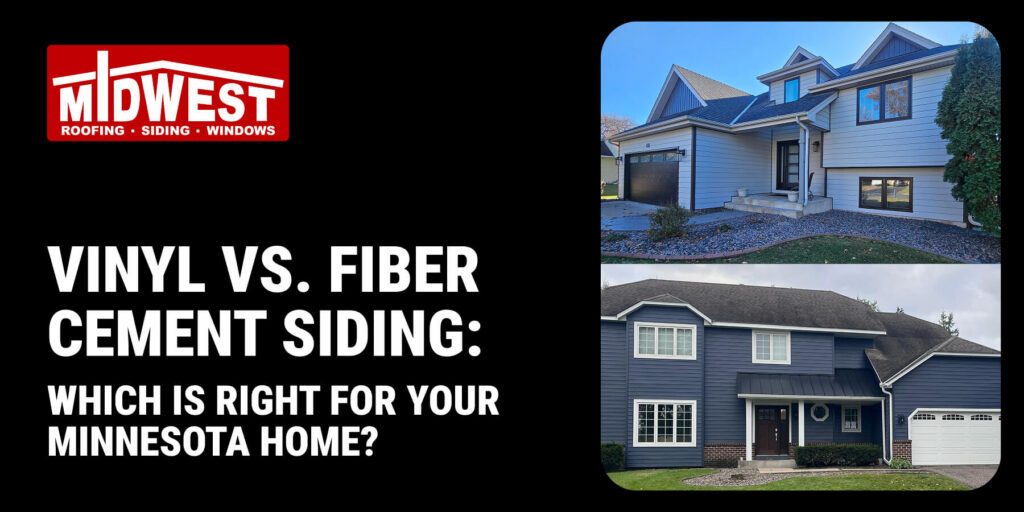
Whether you’re in Minneapolis, St. Paul, Bloomington, Eden Prairie, Maple Grove, Minnetonka, Plymouth, or Blaine, choosing new siding means choosing a material that can handle everything from July humidity to a January wind chill advisory.
If your siding is showing its age — fading, warping, or letting moisture in where it shouldn’t — you’re probably weighing two of the most popular options on the market: vinyl and fiber cement. Both can look great on a Minnesota home. But they perform very differently once winter shows up, and the right choice depends on your budget, your home’s style, and how long you plan to stay in the house. Here’s how the two compare, with our climate specifically in mind.
1. Why Minnesota’s Climate Changes the Decision
Siding manufacturers design and test their products for a national market, but Minnesota homeowners are asking more of their exterior than most. Our siding has to survive a swing from a 20-below wind chill advisory in January to a humid, 90-degree stretch in July — sometimes within the same calendar year. Add in spring freeze-thaw cycles, summer hailstorms, and year-round UV exposure, and it’s easy to see why some siding materials hold up better here than others.
That’s the real question behind vinyl vs. fiber cement: not just which one looks better on move-in day, but which one still looks — and performs — the way you want it to after a decade of Minnesota weather.
2. Vinyl Siding: The Budget-Friendly, Low-Maintenance Option
Vinyl remains one of the most popular siding choices for Twin Cities homeowners, and for good reason.
- Lower upfront cost: Vinyl is typically the more affordable option per square foot, both for materials and installation.
- Low maintenance: No painting required — an occasional rinse with a garden hose is usually enough to keep it looking clean.
- Wide range of colors and styles: Modern vinyl comes in board-and-batten, shake, and traditional lap profiles, with color options that go well beyond the beige-and-white lineup of decades past.
- Insulated options: Insulated vinyl siding adds a layer of foam backing that can help even out those Minnesota temperature swings and modestly improve energy efficiency.
The tradeoff is durability in extreme conditions. In deep cold, standard vinyl can become more brittle and prone to cracking on impact — which matters when a summer hailstorm rolls through. Over many winters, panels can also warp slightly or pull away from the house if they weren’t installed with the right expansion gaps for our climate.
3. Fiber Cement Siding: Built for Minnesota’s Toughest Seasons
Fiber cement — brands like James Hardie are the best-known — is a blend of cement, sand, and cellulose fibers engineered to outlast most other siding materials.
- Impact and hail resistance: Fiber cement holds up significantly better against hail and wind-driven debris than vinyl, which matters given how often the Twin Cities metro sees severe summer storms.
- Won’t warp or rot: It doesn’t expand and contract with temperature the way vinyl does, so it holds its shape through freeze-thaw cycles.
- Fire resistant: Fiber cement is non-combustible, an added layer of protection standard vinyl doesn’t offer.
- Long-lasting color: Factory-applied finishes are baked on and resist fading far longer than standard painted or pigmented siding.
The tradeoffs: fiber cement costs more upfront, it’s heavier and requires an experienced installation crew (this isn’t a material where you want to cut corners on labor), and while factory finishes last a long time, the material will eventually need repainting — just far less often than wood siding ever did.
4. Cost, Maintenance, and Resale Value: Side-by-Side
On paper, vinyl almost always wins on initial price. But the comparison changes when you factor in how long each material actually lasts in our climate and how much upkeep it needs along the way. Vinyl is the better fit if you’re working with a tighter remodeling budget or plan to sell within the next several years. Fiber cement tends to be the stronger long-term investment for homeowners who plan to stay put, especially in neighborhoods that see frequent hail activity.